Showing posts with label earthquake. Show all posts

Tuesday, March 13, 2012

A Year On

Sunday marked a year since the earthquake-tsunami-meltdown. It's been a tough year, emotionally and physically, living in the disaster area, but not.

On Sunday there were ceremonies and moments of silence. At 2.46 pm (the time of the quake), fire trucks sounded their sirens followed by a "mokutou" - where everyone bowed their heads and payed their respects. There were also lighting and candle ceremonies in the prefectural capitals, and prayer services throughout the region.

Ad for a lighting ceremony in my prefectural capital, Morioka, Iwate.

WHERE WE ARE

I haven't been out to the coast since the 3 days I spent there last March. So my impressions of the coast come from friends and TV.

It seems much of the road network is back up. Some of the train tracks have been fixed, but I'm not sure how much. The airport in Sendai is running. People are rebuilding. There is still a long way to go. A long, long way, but everybody is dealing with it.

We're still on setsuden - electricity conservation measures. Noone seems to know if or when power plants will generate enough energy to support East Japan again. But we seem to be getting by on what we have. Everyone is conscientious about energy use.

WHERE I AM

I can't explain the emotion I feel in regard to the disaster. I lived through it, like people all over Tohoku. I live way too many miles in land to have been in danger of tsunami, but I went through the thousands of earthquakes with everybody else. My colleague and I started joking that anything under 6.0 wasn't even worth the time. It sounds offhand and callous, but when you experience 100 earthquakes in a day, you have to deal some way.

It's hard for me to deal with the coast. My TV broke and I didn't get a new one. That's partially because I don't want to pay NHK's ridiculous licensing fee. But it's also because there's tsunami are coverage every day, and I can't take it. I guess it's different when you've been there. You've seen my tsunami area pics. Imagine travelling to somewhere - somewhere you've been before, where there used to be houses and buildings and schools - and there's nothing. There's not even debris, no grass, just dirt, as far as your eye can see. I still can't get down to Ritz (Rikuzentakata) where my colleague, Monty Dickson, was claimed by the tsunami. I just can't face the place.

It's still hard to deal with how unaffected I was. I'm an hour inland. One drink fell over in the drink machine and an antenna fell off at work. We ran out of New Zealand Cheese and toilet paper. (My town is a farming town, so we were good for food.) We ran out of gas. The power went off. The trains didn't run for a week. The shinkansen (bullet train) didn't run for over a month, and then when it did run, it ran an hour slower. Due east of me another colleague spent her post-tsunami days cutting up cloth to cover dead bodies. I got off easy.

WHAT I HAVE TAKEN

I am still glad I was here. I am still glad I AM here. Living through the past year has taught me so much about the human condition. What love really is. How much people can help one another. How much they want to.

And it's taught me so much about me. About who I become in a bad situation. About how far I can go before I can't take any more. I know how I can be helpful, and how it all feels. It's made me understand that sometimes, when the world crumbles, all you can do is to keep moving as best you can. Never forget, no, always carry those memories with you. They make you stronger and better. But always keep moving.

Thank you, Tohoku. I will keep moving. ありがとう東北。続きます。

Tuesday, April 12, 2011

Sad News


My neighbour (with mike) and Monty at karaoke in Tokyo, August 2009.

You've probably heard me talk about missing friends recently.

Monty Dickson was reported as missing after the tsunami of March 11. One of the first images we saw when power returned here was the town of Rikuzentakata. Watching, as the wave devoured the main city area, I said to my neighbours, "That's Monty's town. I hope he's alright."

Information was slow coming out of Takata, as we call it for short. Eventually we heard that Monty had spoken to his girlfriend right after the quake. He told her he'd evacuated to the 3rd floor of the City Hall, as he was supposed to. That very night, we saw an interview with a woman from Takata. She'd been at City Hall and left to go to the library and get her daughter. When the wave hit, they were pulled apart. Then they showed a picture of where the City Hall used to be.

Nothing.

Last week Tuesday (Monday on your side of the world) they found a body fitting Monty's description. His girlfriend went to identify him.

As per usual, we found out on Facebook. This is one of the biggest cultural differences I've experienced here. In the West, information goes out as fast as you can get it out. In Japan, there's a chain of command to everything. All the right people have to be informed first and what's not. So I read the article on World Blog before it was officially announced here. I understand this now, but it took some getting used to.

I first met Monty in Tokyo almost 2 years ago. We're both participants on the JET and I went down to Tokyo as a 'sempai' (=senior) JET from Iwate to orientate the newbies. Monty and I weren't close friends, and since we lived at opposite ends of the biggest mainland prefecture, we really only met up at official prefectural events. (A prefecture is like the American equivalent of a state. Only much, much tinier.) Monty had an amazingly subtle sense of humour. My neighbour absolutely loved it.

He also had the most incredible Japanese, something which I really admire. (Even though Japanese is my 4th foreign language, it does not come easy. And while I get by in any situation you throw me into, I'd never tell you I'm fluent.) A fact that no doubt contributed to the fact that he was practically a superhero in Takata. Monty integrated so well into his community that the last time I saw him was in February, when my neighbour opened up a Japanese travel magazine and was shocked to find Monty smiling out at him. 流石, Monty-san, 流石.

Rest In Peace Eternal.

NB. 流石 is pronounced sasuga, and means "just as expected".

Friday, April 8, 2011

safe

safe after 7.4 quake. Without power. Love my kindle. Tired of shaking earth.

Saturday, April 2, 2011

3 Days in the tsunami area

Thanks to all who've already contributed to the 100 Books Every Writer Should Read . Keep spreading the word and sending your lists of 10. (Btw, there are already patterns emerging. The first 3 lists all contained a particular book which I haven't read. lol)

As you know, I headed out to the coast on Monday to help in the tsunami. I went through the town church.

MONDAY
Our first stop was a church in Miyako, a city about an hour and a half drive South of here on the coast. We spent most of the afternoon walking around the neighbourhood with the Tokyo YMCA spreading limestone dust on the ground in the roads and in some of the old folks' houses. The guys helped another old lady clean up her shop. The population in the countryside is over 33% senior citizens.

MIYAKO

I don't even know how this car got in here. There were houses on all 4 sides...


70 footer parked in the midle of an intersection.


My neighbour after we'd finished spreading around the chalk.


Chalky me, pointing out the mark on the kindergarten van where the water went up to.


Overtaking a boat in the road.


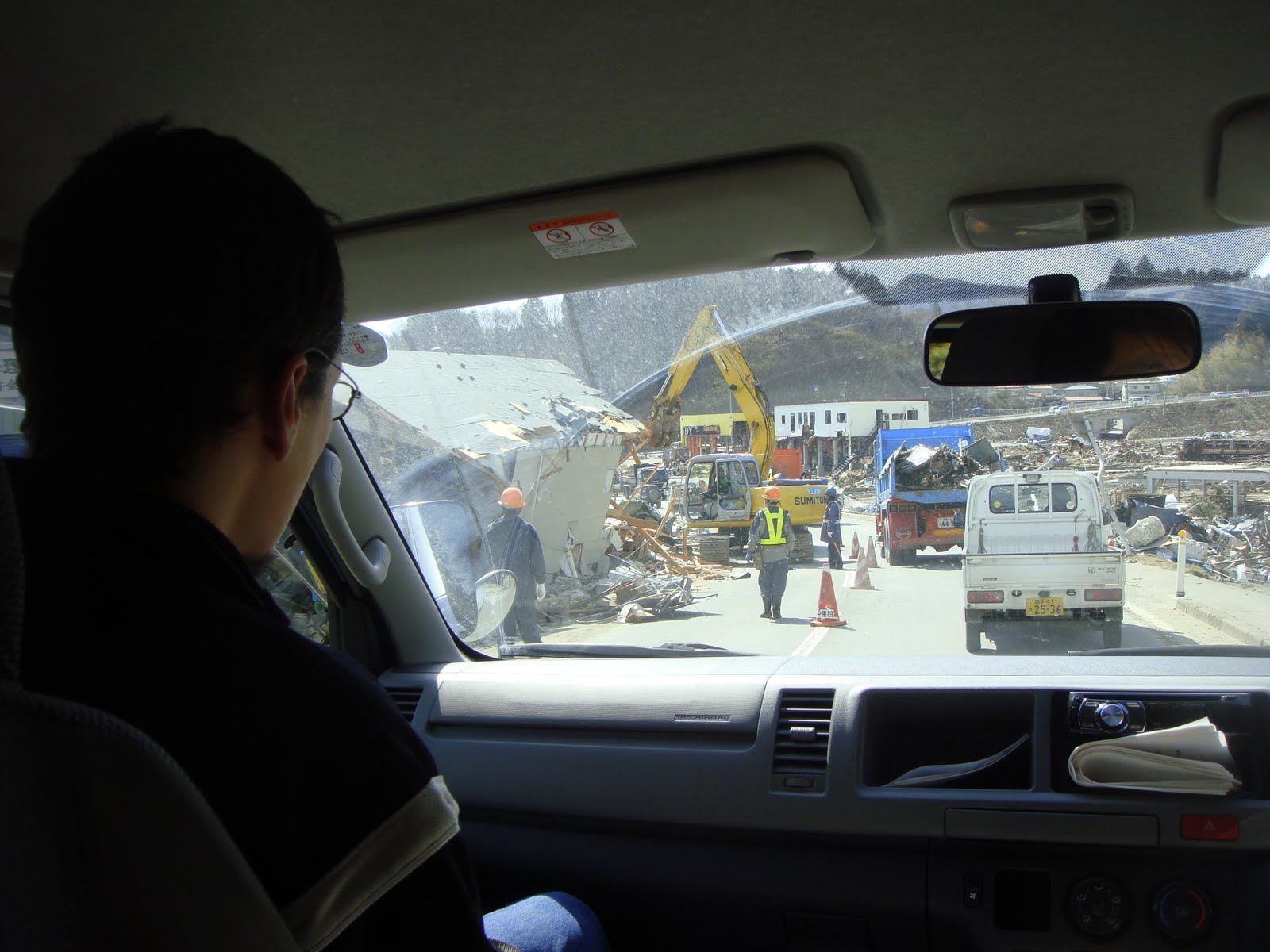
Japan Self Defense Force hard at work.


After work, we headed down to the bay with the group from Morioka (prefectural capital) and Aomori, the prefecture above us. This two story building was flipped and broken in two.


These pics were taken from the top of the sea wall.


The road disintegrated in some areas.


This log landed on top of the sea wall ladder, about 30 ft above sea level.


Boats overturned and run aground.


Stitch.. Every time I saw a toy or doll I wondered about the kid who used to own it.


The seats in the lower left corner probably came from the baseball stadium in the upper right.


Piles of debris on the sides of the road. The crazy thing about Miyako is that you could draw a line between the devastated area and the unaffected area. Our driver told us as we got to the train station, "As soon as we cross this intersection, you will see the damage."


I joked that Toyota must be glad they got the high ground.


Bad joke. Mitsubishi, Daihatsu and Suzuki's other outlet were not so lucky.


Cars on Daihatsu's lot.

The girls spent the night at the kindergarten and the boys at the church. The area the church was in didn't have power back yet, though.

TUESDAY
In the morning we had breakfast and set out for Kamaishi, passing through Yamada and Otsuchi.

YAMADA

Yamada was hit harder than Miyako. It was a tiny bit closer to the epicenter and it's a little lower elevation.


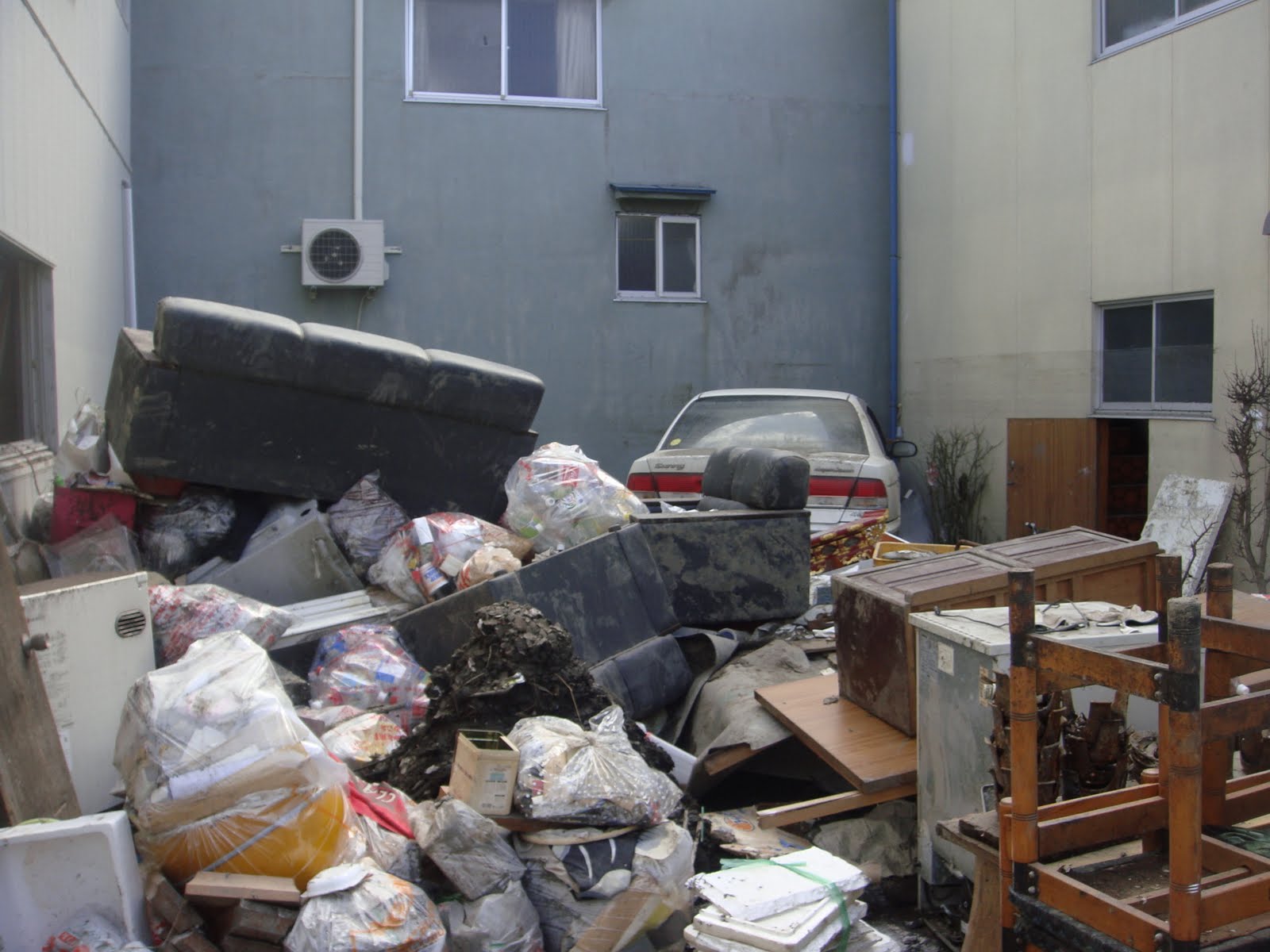
Devastated home store.


Boats on the side of the road.


We think the red spray paint was the army's markings, but we're not sure what they meant.


A boat on a store roof.


A house on its side in the road.


A section of the sea wall crumbled.


The river banks.


Dressed for a day of hard work. The hotel behind me had it's first 2 floors devasted, but everything above that was fine.

OTSUCHI


Debris mountains on the river bank.


The Mitsubishi sign, but no building and no cars.


The second story of a house. This was actually pretty common. I think the first story probably crumbled with the pressure, but the 2nd stories floated.

There was a stretch of impassable road on Route 45, so we took the expressway to Kamaishi.

KAMAISHI
The plan was to clean the church out so there'd be a place to store donated goods and for volunteers to camp out. There is still no power in the area and the bathroom doors all came off, which meant the girls had to use the porta-potties at the hospital next door. The stove was destroyed so we cooked on camp stoves with portable spray cans of gas.


The kitchen at the church after we'd been cleaning for an hour. The tsunami was much taller here. Even though we were a couple blocks in from the coast, water reached the second story of the building.


A car parked on top of a roadside fence.


The base of operations for Police and Red Cross. JSDF was camped a little further on at a Junior High School School is out right now. It's actually the end of the school year. The earth quake happened on the last day of school.


It is life as usual just a little further on. The devasted areas in the towns we visited extended less than a mile from the shore.


We spent the night at a church in Tono, which is inland of Kamaishi. (Apparently it takes 5 people to fill up the can with gas. We were travelling with cans of gas because of the ridiculous lines in gas stations. I think the priests and volunteers coming in from outside the area must have brought gas with them.)

WEDNESDAY

KAMAISHI

We headed back to the church in Kamaishi after breakfast and a short Thanksgiving service.

Somehow I didn't notice this car wrapped around a pole on the first day. It was right across the road from the church.


The license plates of cars which had been removed. You may not be able to see it, but it also includes where they were found, eg. 'in a pole in front of the church.'


It was only after the second full day at the Kamaishi church that we realised that the stained glass was a depiction of the Great Flood. Eerie.


The kitchen after 8 hours of being cleaned by 14 or so people. (All the people in my volunteer group. They was also a group from Hokkaido, but they were working on the building next door. As well as a group of American missionaries who live in Nagano, who were working with the donated stuff.)


Final meal of the trip at a ramen shop just before getting on the interstate at Towa.

The trip left me with a weird mix of feelings. I don't think anyone could come through that much devastation without getting a little depressed. But I was also pleasantly surprised to meet priests and Christians from 5 prefectures (Hokkaido, Aomori, Iwate, Tokyo, Ehime). Christians represent less than .1% of Japanese population.

I was happy to see the spirit of the people in the area. Everybody was cleaning their homes or stores or helping someone else clean theirs. Everybody was smiling. Even though many of them had only the frames of their buildings left.

And even though I feel weird about it, I actually had a good time. You can't really spend 2 days scraping mudd out of the insides of pianos and organs and stoves and not make friends.

So, there you have it. My 3 days on the coast.

Tuesday, March 22, 2011

Aftershocks

Thank you guys for all your concern.

It's been a very emotional time for me, and since today is Monday (well, it's Tuesday here, but Monday was a holiday and we don't have internet at home since the quake...), I'm going to share what's on my mind. Namely lots of emotions.

I FEEL ANNOYED

I have been following the Japanese news (usually with English simul-translation) so I haven't seen the Western Media. But I hear it's a hot fear-mongering mess.

Granted, Japan is a lot smaller than the US, but that does not mean you can see from one side to the next. I live 600 km outside of Tokyo, and that is still close compared to where some of my friends live. I would really appreciate it if someone in the media would point out that outside the tsunami towns (in 3 prefectures) and the radiation possibilities (in about 4 more), the other 40 prefectures are largely unaffected. My friend in Fukuoka (on a different island in the South) felt NOTHING. They watched the quake on tv like everyone else. That's how far away they were.

Honestly, seeing the situation on the ground, and hearing the way the major networks portray it, is making me wonder how much they overblew other disasters.

I FEEL STRESSED

Thanks to the media-induced hysteria, people keep asking me if I'm coming home. I know they mean well, but I am 450 km away from the nuclear plant, and I'm keeping track of the situation. The Japanese government says this distance is fine. The US Government (despite what the media selectively portrays) says this distance is fine. My neighbour's Radiation Safety Specialist aunt says this distance is fine. So all the people calling me in hysterics because supposedly reputable television stations told them that the whole archipelago is going to fall into the sea- yes, I understand you're concerned, but I am fine.

I FEEL USELESS

I live about 100 km inland of some of the places you've seen on tv. (That's just me guessing though.) But I'm right here. I feel like I should be out there doing something. And somehow there doesn't seem to be any way for me to help. I can't find an organisation which wants my assistance and the prefecture has advised not to go out there on our own. I can't donate food because we're affected by the same shortages.

I FEEL BLESSED

In the midst of how bad things are, I keep thinking of all the ways it could have been worse and all the things I'm thankful for.

I'm glad that the grand majority of my friends have been accounted for.

I'm glad I was sitting right next to my neighbours when it happened, so I knew they were safe.

I'm glad we were with Japanese teachers, so they gave us the information which might have been difficult for us to figure out on our own.

I'm glad it happened in the middle of the night for the Western Hemisphere. I can't imagine how much more freaked out ppl might have been watching it live.

I'm glad that I live in a farming town, so while we have shortages on gas and processed goods, we will never run out of pork, chicken, rice and vegetables.

I'm glad that, even though we were so close to the epicenter, my town's only damage seems to be a drink that fell over in the drink machine display case and an antenna that fell off the municipal offices.

I'm glad that I had a Kindle, because when my cellphone died, and the landlines and power were off, it was my only way of communicating with the outside world. (Still kind of is, since my internet home is off.)


I FEEL GUILTY

It's weird living through a disaster (again- guess who was on a plane on September 11, 2001). I feel like I should be more affected. I spend half my time moping around worrying about people. Another chunk I spend wishing life would just go back to normal because I'm so stressed. And then I feel guilty because thousands lost their lives and I'm only mildly inconvenienced by the unavailability of toilet paper, feminine products and New Zealand cheese. I want to get back to regular life. But I feel guilty that my life is so regular. When some of my friends are missing, without power and water, living in shelters.

Monday, that's on my mind. Also don't forget to enter to win a copy of WHAT KATY DID. Remember I'll donate for each person that enters.

Wednesday, March 16, 2011

How you can help Japan

Hi guys,

By now, I'm sure you've heard what happened in Japan. Here are 3 ways you can donate.

1. Red Cross on Amazon.com.

2. Authors for Japan. Some amazing, amazing authors have gotten together to auction awesome prizes. Thank you, guys!

3. Enter this week's book giveaway (not up yet- sketchy internet, sorry) and I will donate 200 yen (about $2USD) for every person who enters. Spread the word.

Sunday, March 13, 2011

Safe

I am safe. I am in Iwate where most of the tsunami occured but I'm way inland. We were without power for a day, but it is back now. I will do a full post when I have internet access. (Updating from my Kindle.) Thank you for your thoughts. I still have afew missing friends in other townws. Please keep them in your thoughts and prayers.